Presenting data through graphs and charts is one of the most remarkable features of mobile applications today. iOS Charts make apps look more beautiful and noticeably more attractive. We already integrated a number of Swift Charts into many mobile app templates such as the Dashboard iOS App Template or Personal Finance iOS App Template.
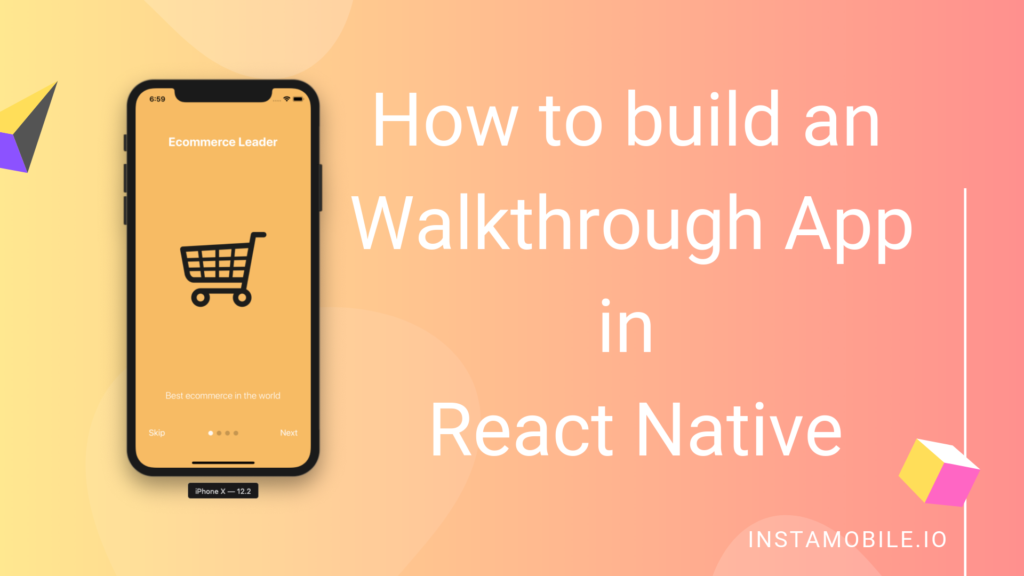
An App Walkthrough Screen is a slider screen which allows the user to learn everything about the features of a mobile app when they open the application for the first time. We can implement this feature in a React Native application in multiple ways. In this React Native tutorial, we describe how we implemented the Walkthrough Screens in all of our React Native Templates so that you can speed up your app development by reusing our open source code.
When designing a template for your mobile app, there’s always the need of using images, icons, and various other UI assets. If you’re only working on a prototype, investing too much time or money for purchasing these assets is not really worth it, so you always end up looking for free mobile icons and images. In this article, we list a handful of websites that offer free mobile icons and images, which you can use in your mobile app, without worrying about copyright infringement.
Flutter is a cross-platform application development framework released in December 2018 by Google. Since then, its community has been growing rapidly,
and the Flutter framework is being adopted by many top-level software development companies. Let’s take a look at how you can create your first Flutter app in no time.
In today’s privacy-focused world, keeping a high bar for the security of our iOS apps, by storing critical user data securely is more important than ever. When handling sensitive user data such as passwords, in-app purchases, etc, in iOS apps, a mobile developer needs to take security into consideration. In our App Templates, we are taking security very seriously, by making it part of our core values. In this tutorial, we will show you how to use the Keychain in Swift to store sensitive user data by implementing a persistent login feature on iOS.
Sign in with Apple is a common requirement for React Native apps that offer
third-party login options such as Google, Facebook, LinkedIn, or Amazon. It also
gives iOS users a privacy-friendly authentication option that works well with
Firebase Authentication.
As we have mentioned in previous posts, there are more and more iOS applications in App Store and obviously we are living in a highly competitive market. Hence, creativity and differentiation are essential for success. In today’s article, we will show you a great feature that makes apps feel more playful and performant – haptic feedback. We’ll learn how to generate haptics feedback in Swift with code examples.
Optional imports are useful when a React Native app has platform-specific code,
feature-gated screens, optional assets, or native modules that should only load
in one environment. They are also easy to misuse. Metro still needs to know what
files can be bundled, so arbitrary runtime strings are not a good import
strategy.
iOS has built-in support for adding shadows to UIView components. All you need to do in order to add a shadow to a UIView object is to set the shadow properties of the view’s layer. Shadows are a powerful user interface design element, making the visual components stand out by giving them a 3D look and feel. In order to display a shadow in Swift, iOS allows you to specify its color, opacity, offset and radius. Our recommendation is to try out different values for these variables, to see for yourself what are they exactly.
Push notifications are one of the highest-leverage features in a React Native
app, but they are also easy to get wrong. Firebase Cloud Messaging can deliver
messages to Android and iOS, but iOS still depends on APNs, modern Android
requires runtime notification permission, and every production app needs a
trusted backend to send notifications.
This guide focuses on the current architecture: the mobile app requests
permission and stores device tokens; Firebase owns delivery; your backend sends
messages with Firebase Admin SDK or FCM HTTP v1.
Localization is the process of adapting an app for the languages, regions, layouts, and expectations of the people using it. This iOS guide focuses on why localization matters and how to prepare a Swift app before translation becomes expensive.
Phones, tablets, and foldables have status bars, notches, camera cutouts, rounded
corners, gesture home indicators, and navigation bars. A React Native screen
that looks fine on one simulator can still hide content under system UI on
another device.
The modern solution is react-native-safe-area-context. The older
SafeAreaView exported from React Native core is deprecated and should not be
the default choice for new work.
Practical product notes
Get the next useful guide
Occasional tutorials, product resources, and lessons from building and launching software.